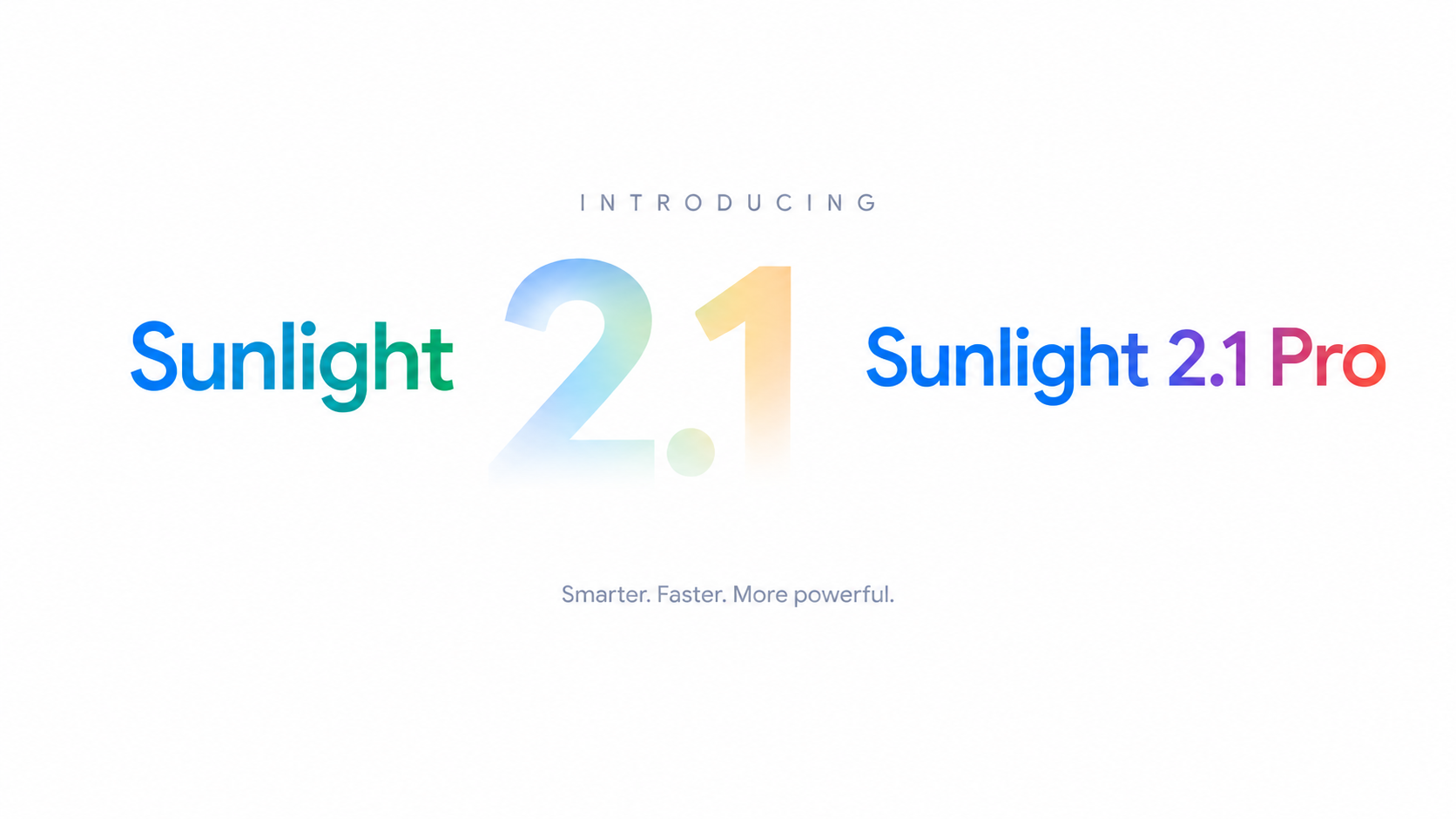
Introducing Sunlight 2.1 and Sunlight 2.1 Pro
Our next generation of AI models brings stronger reasoning, improved coding capabilities, and a more capable assistant to Sunlight and Meteor.
When we launched Sunlight, we set out to build AI that is genuinely useful: an assistant that helps people think, create, learn, and get things done. Since then, Sunlight has been built around that goal, with a focus on making advanced AI practical for everyday life and serious work alike.
Today, we're introducing Sunlight 2.1 and Sunlight 2.1 Pro, our next generation of AI models and our most capable models to date.
This release focuses on the things that matter most when people work with AI: reasoning through difficult problems, writing and understanding code, following detailed instructions, and producing answers that are useful, clear, and reliable.
We're beginning with a beta for selected users and partner companies. On November 4, we'll begin rolling out both models to all Sunlight users and bringing them to Meteor, our agentic coding IDE.
Why we built Sunlight 2.1
The way people use AI is changing. What began as a way to ask questions and get quick answers has become a tool for real work: drafting reports, analyzing data, debugging software, planning projects, and learning new skills.
These tasks require more than a fast response. They require an understanding of context, careful reasoning, attention to detail, and the ability to follow a task through multiple steps.
That's what guided our work on Sunlight 2.1.
We focused on three priorities:
- Intelligence: Better performance on complex questions, multistep problems, and tasks that require connecting ideas.
- Reliability: More consistent answers, stronger instruction-following, and greater care when dealing with uncertainty.
- Helpfulness: An assistant that adapts to the task, understands the intent behind a request, and produces practical results.
The objective isn't simply to make a model more powerful. It's to make that capability useful in the moments when people need it.
Meet the models
Sunlight 2.1
Sunlight 2.1 is our everyday model, designed to balance capability, responsiveness, and versatility. It is the default choice for the tasks people bring to Sunlight throughout the day.
Sunlight 2.1 is designed for:
- Writing and editing: Drafting emails, essays, posts, and documents while helping you refine your own voice.
- Research and learning: Breaking down difficult topics, summarizing material, and exploring unfamiliar subjects.
- Everyday problem-solving: Comparing options, organizing plans, and working through decisions.
- Conversation: Natural, context-aware exchanges that help you explore ideas and move from questions to answers.
Whether you're writing your first draft, learning something new, or organizing a complicated project, Sunlight 2.1 is built to help you make progress without unnecessary complexity.
Sunlight 2.1 Pro
Sunlight 2.1 Pro is our most advanced model, designed for tasks that demand deeper reasoning, sustained attention, and greater precision.
It's built for people who need more from their AI assistant, particularly when the work is complex or the details matter.
Sunlight 2.1 Pro is designed for:
- Complex reasoning: Working through challenging mathematics, scientific questions, logical problems, and multistep analysis.
- Advanced coding: Writing, reviewing, debugging, and improving code across larger projects.
- Long-form work: Maintaining context across detailed documents, extended conversations, and tasks with many dependencies.
- Professional workflows: Supporting research, engineering, analysis, and other work where careful reasoning is essential.
Sunlight 2.1 is built for the breadth of everyday work. Sunlight 2.1 Pro is built to take on its most demanding parts.
What's new in Sunlight 2.1
Stronger reasoning
Sunlight 2.1 and Sunlight 2.1 Pro bring improvements to complex problem-solving. They're designed to handle tasks that require multiple steps, connect information from different parts of a problem, and produce more coherent conclusions.
That matters because difficult questions rarely have a single obvious answer. Useful reasoning means understanding the problem, considering relevant constraints, and reaching a conclusion that follows from the available information.
Better coding
Software development is one of the most demanding applications of modern AI. Writing a working function is one thing; understanding an existing codebase, tracking down a difficult bug, and making a change without breaking other components is another.
Sunlight 2.1 improves our focus on coding, with Sunlight 2.1 Pro aimed at more demanding development tasks. Both models are designed to help developers understand code, investigate problems, implement changes, and improve existing software.
Through Meteor, we're bringing these capabilities into a development environment built around agentic workflows, where developers can work with AI on projects rather than treating every question as an isolated interaction.
Better instruction-following
Good AI should follow the task you actually describe, not substitute a different one.
Sunlight 2.1 places greater emphasis on understanding detailed requests, respecting constraints, and maintaining the requested format and tone. Whether you're preparing a structured report, refining a piece of writing, or working toward a technical specification, the model is designed to stay closer to your requirements.
More consistent answers
We've made consistency and reliability central priorities for this release.
Sunlight 2.1 is designed to provide more coherent responses, maintain context more effectively, and handle detailed instructions with greater care. As with any AI model, mistakes remain possible, and important information should still be verified.
Our goal is to make Sunlight a more dependable tool for work that matters, without asking users to assume that every answer is automatically correct.
A more capable development experience
Sunlight 2.1 Pro is designed to support longer and more involved coding tasks, particularly when a change requires understanding how different components of a project fit together.
Combined with Meteor, this creates a more natural workflow: describe a goal, explore the existing implementation, develop an approach, and work through the changes with AI assistance.
How Sunlight 2.1 performs
The following benchmark results compare Sunlight 2.0, Sunlight 2.1, and Sunlight 2.1 Pro.
| Benchmark | Sunlight 2.0 | Sunlight 2.1 | Sunlight 2.1 Pro |
|---|---|---|---|
| GPQA Diamond | 92.8% | 92.9% | 96.0% |
| FrontierCode 1.1 Extended | 57.7% | 63.4% | 64.5% |
| FrontierMath Tier 4 | 27.1% | 68.3% | 97.6% |
| Humanity's Last Exam (with tools) | 52.1% | Not reported | 57.2% |
Benchmarks offer a useful way to compare models on defined tasks, but they don't capture every aspect of real-world performance. Results can depend on evaluation methods, available tools, and testing conditions.
That's why we're starting with a beta. We want to evaluate how Sunlight 2.1 performs in real workflows, understand where it excels, and identify where further improvements are needed.
Built for building with Meteor
Meteor is our agentic coding IDE, designed to help developers move from an idea to working software.
Starting November 4, Sunlight 2.1 and Sunlight 2.1 Pro will begin rolling out to Meteor, bringing our latest models into the development workflow.
With Sunlight 2.1 Pro, developers will be able to use AI assistance to:
- Plan and build features: Break a development goal into manageable steps and work through implementation across a project.
- Understand unfamiliar code: Explore how a codebase works, trace dependencies, and identify where changes belong.
- Investigate bugs: Analyze errors, explore possible causes, and develop and evaluate fixes.
- Improve existing software: Work on refactoring, tests, dependency updates, and documentation.
The goal is to reduce the repetitive work that slows development down while giving developers more time to focus on architecture, product decisions, and the details that require human judgment.
AI-assisted development works best when developers remain able to inspect changes, understand proposed solutions, and decide what ultimately belongs in their projects. Meteor is being developed around that principle.
For businesses and partners
AI becomes especially valuable when it can support the real workflows people already use.
We're working with partner companies to evaluate Sunlight 2.1 across practical applications, including customer support, data analysis, software development, and research.
The beta gives us an opportunity to learn from a broader range of tasks, gather feedback from people using the models in practice, and identify improvements that may not be apparent from benchmark evaluations alone.
For organizations interested in working with Sunlight, our partner program provides a starting point for exploring collaboration.
Learn more at yavqo.com/partners.
Building responsibly
More capable AI brings greater opportunities, but it also raises the importance of careful development, testing, and deployment.
Our approach to Sunlight 2.1 includes evaluating model behavior, examining potential misuse risks, and identifying areas where additional safeguards may be necessary.
We believe responsible development requires ongoing work rather than a single assessment before launch. Models can behave differently across contexts, and real-world use can reveal weaknesses that controlled evaluations miss.
The limited beta is part of this process. By beginning with selected users and partner companies, we can collect feedback, evaluate practical performance, and make informed improvements as the rollout progresses.
We'll continue developing our approach to safety and reliability alongside the capabilities of our models.
Your privacy
Privacy is an important part of building AI that people can use with confidence.
Sunlight users can review our published privacy terms to understand how personal information is handled when using our services, including the applicable terms governing data processing and user rights.
We encourage users and organizations to review the Yavqo Privacy Policy before sharing personal, confidential, or otherwise sensitive information with Sunlight.
Availability
Sunlight 2.1 and Sunlight 2.1 Pro will be introduced in two stages.
Starting October 28: The beta begins for selected users and partner companies through Sunlight.
November 4: The planned broader rollout begins, bringing both models to Sunlight users and introducing them to Meteor.
Access may vary during the rollout as availability expands. Further information about model access and subscription eligibility will be provided through the relevant product experiences.
What's next
Sunlight 2.1 and Sunlight 2.1 Pro represent another step toward our broader goal: making advanced AI useful across the ways people think, work, learn, and create.
We'll continue improving our models, expanding their practical applications, and developing products that make those capabilities accessible in everyday workflows.
We're grateful to everyone who has used Sunlight, shared feedback, and helped shape its development. Building useful AI is an ongoing process, and the way people use these tools will continue to influence what we build next.
Sunlight 2.1 is the next step. We're looking forward to what you'll build with it.
Explore Sunlight at sunlight.yavqo.com.